Recherches récentes
Idées de recherche
Échelle
This truly iconic, originally Soviet-made ground-attack aircraft earned its reputation across several battlefields and in the service of multiple militaries. Its first prototype took to the skies on February 22, 1975, at the Zhukovsky test center (located near the town of Ramenskoye). Three years later, in 1978, it entered serial production in the city of Tbilisi, in what was then the Georgian Soviet Socialist Republic. This remained its primary production site until manufacturing definitively ended in 2017. Between 1978 and 2017, a total of 1,024 units were produced.
Like almost any famous machine, the Su-25 has earned its share of characteristic nicknames. In its homeland, the Soviet Union, it received one such moniker during the war in Afghanistan in the 1980s. Due to its specific combat style—where the aircraft circles over the battlefield and literally "picks off" its targets—pilots began calling it Grach / Грач (meaning Rook). This fitting nickname became so popular that pilots started painting angry rooks on the fuselages of their aircraft.
In contrast, the Russian infantry gave the aircraft the nickname Rascheska / Расчёска (meaning Comb), mostly due to how it looked from below. This designation came about because of the massive weapon pylons for bombs and rockets. When the aircraft was fully armed, its silhouette reminded the soldiers on the ground of a hair comb.
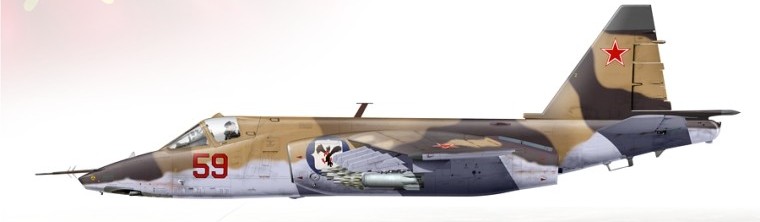
NATO uses a specific naming system for Soviet and Russian military hardware, primarily to avoid confusion in the heat of battle. Western analysts gave the Su-25 the reporting name Frogfoot. This designation is not only distinctive but also has a logical basis. The letter F is used to designate fighter and ground-attack aircraft (Fighters), such as the Frogfoot (Su-25), Flanker (Su-27), or Fulcrum (MiG-29).
The second rule of the NATO system determines the aircraft's propulsion based on the number of syllables: single-syllable names indicate propeller propulsion, while two-syllable names indicate a jet engine. Hence the name Frog-foot—it starts with the letter F (combat aircraft) and has two syllables because it is powered by two jet engines.
But why "Frogfoot" specifically? It is mostly due to its operational style. The Su-25 operates at low altitudes alongside infantry, metaphorically close to the ground, "in the mud and dust" like a frog. Its robust landing gear also played a significant role in this nickname. Thanks to its massive construction and wide tires, it is designed to operate from unpaved airstrips, which might have reminded observers of hunched frog legs.
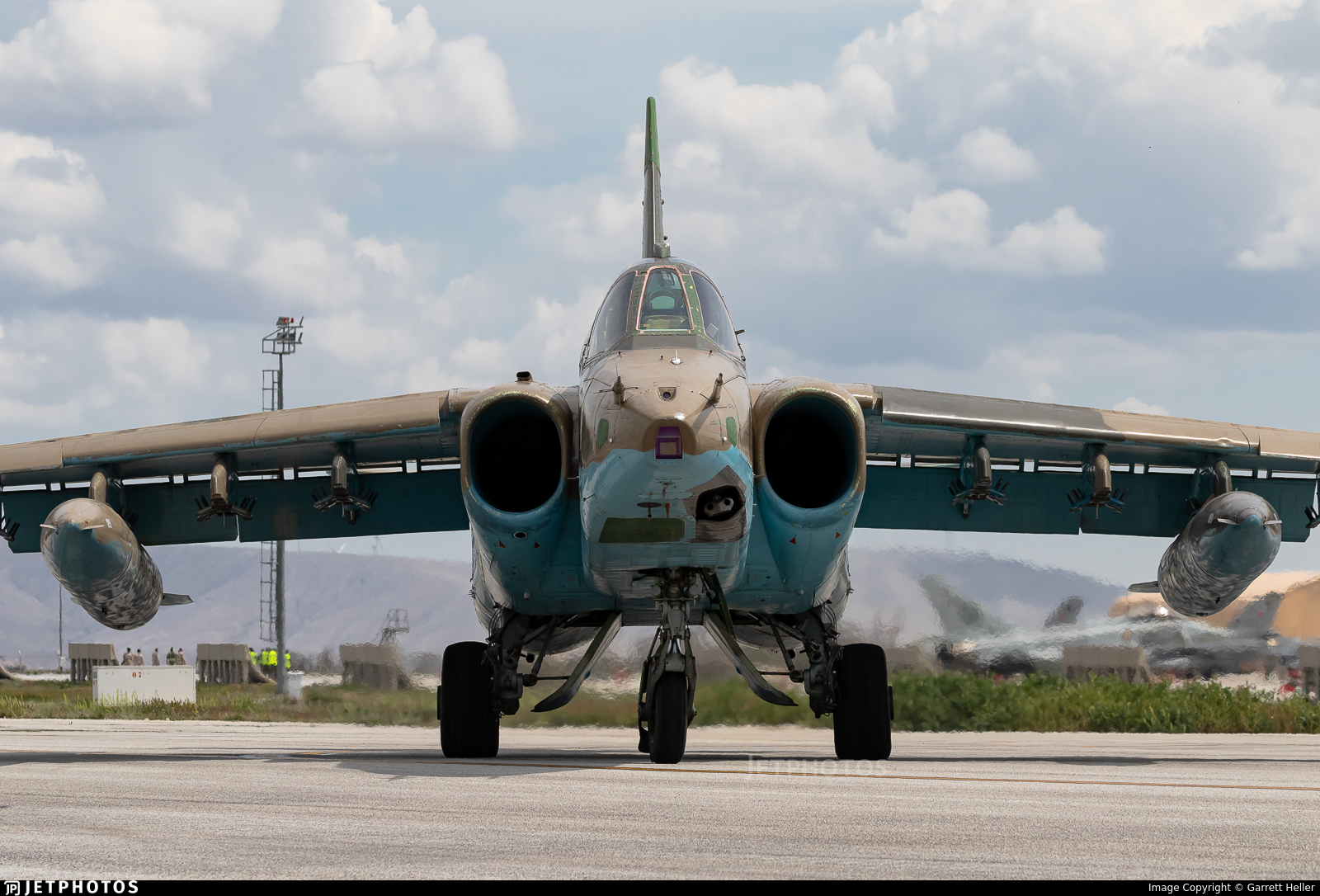
The Su-25 was also part of our inventory. It had its own nicknames here too, but unlike the Russians, we didn't call it a comb, but rather "hrábě" (Rake). Czechs, being a nation of avid gardeners, simply felt closer to this garden tool than a comb. Just like in Russia, this nickname came from the ten massive weapon pylons under the wings.
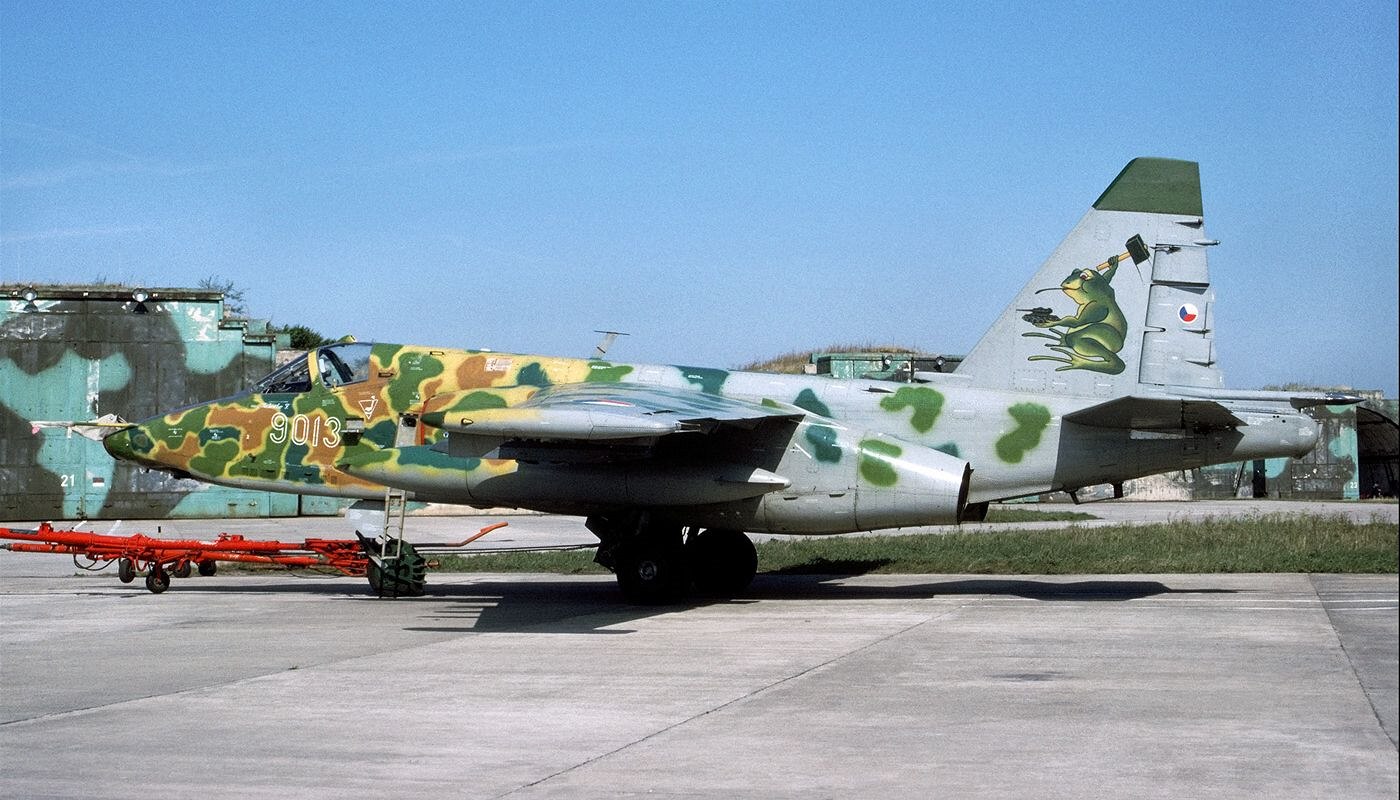
However, that wasn't the only nickname. As mentioned before, due to its low-altitude deployment and—in our conditions—its typical camouflage (shades of green and brown), the nickname "Žabák" (The Toad/Frog) firmly stuck in the Czech Republic. As the aircraft neared the end of its service in the late 1990s, technicians and pilots from the 32nd Tactical Air Base in Náměšť nad Oslavou decided to create a unique promotional paint scheme. They chose an aircraft with the fuselage number 9013 and painted an angry green frog on its vertical stabilizer, holding a blacksmith's hammer and smashing a tank. This specific aircraft became a legend, especially thanks to its impressive performances at airshows. After the type was definitively retired from the Czech Air Force, the legendary "Žabák" moved to the Kbely Aviation Museum in Prague, where it can still be seen today.
Crew: 1
Length: 15.53 m
Wingspan: 14.36 m
Height: 4.8 m
Wing area: 30.1 m²
Empty weight: 10,740 kg
Takeoff weight: 17,530 kg
Maximum takeoff weight: 20,500 kg
Powerplant: 2× Soyuz/Gavrilov R-95Sh turbojet engines, producing 40.21 kN of thrust each
Maximum speed at sea level: 950 km/h
Range: 1,950 km
Service ceiling:
With external stores: 5,000 m
Clean (without external stores): 7,000 – 10,000 m
Maximum reached during test flights: 14,600 m
Time to maximum service ceiling: under 2 minutes
Initial rate of climb: 58 m/s
Wing loading: 584 kg/m²
Thrust/weight ratio: 0.51
Cannon: 1× 30mm twin-barrel GSh-30-2 autocannon with 250 rounds
Hardpoints: 10 wing pylons with a total payload capacity of up to 4,400 kg
2× R-60 (AA-8 Aphid) missiles, outer pylons only
Drop tanks
250 kg BETA B-250 bombs
Kh-23 (AS-7 "Kerry") missiles
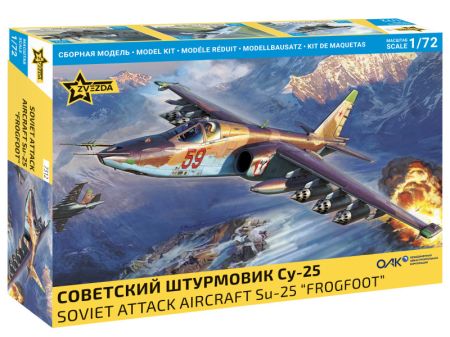
Did the story of this indestructible and armed-to-the-teeth ground-attack aircraft captivate you? Now you can build your own legendary scale replica right on your modeling workbench. The highly anticipated new release from Zvezda has just arrived at our MN-Modelář e-shop—a highly detailed 1:72 scale plastic model of the Su-25 "Frogfoot".
On behalf of the MN-Modelář team,
Filip K.